Showing posts with label Mary Mead Rex. Show all posts

Wednesday, March 30, 2011

Ada Rex Jackson writes of her family. Concluded.

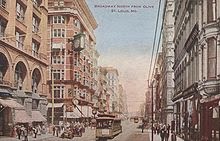
Downtown St. Louis, Missouri, Broadway, 1910. Continued from here: When Mary Mead Rex traveled from St. Louis, Missouri to Randolph, Utah in 1871, her son Thomas John Rex stayed behind in St. Louis. Mary Mead Rex’s granddaughters, Ada Rex, and cousin Julia Rex, wrote to one another. St. Louis, Mo. Dec. 27, 1899 Dear Cousin Ada. I was very glad to here [sic] from you. I am going to be fifteen years old in April. I am in the fifth reader and I have the large Arithmetic. My teachers name is Miss Roby. Our school has 32 rooms in it. There is a park right across from our school and when it snows we have a nice time coasting down the hill. There is about an inch and a half of snow on the ground. We do not have such large snow storms here as you do there. But when we do have a pretty good snow we have good sport while it lasts. Well Ada. I am getting sleepy and tired so I guess I'll close. Your loving cousin, Julia Rex
My earliest school days were in the early spring of 1898. In those days the older boys had to stay out of school to help on the farms. They would take in a beginners class and that was the first year that I went to school. My first teacher was Rhoda B. Cool of Logan. Utah. She was a very lovely woman and a very wonderful teacher. She later taught in the Utah State Agricultural College. She lived in Logan the remainder of her life. We all loved her. To know her was to love her. That six weeks in the spring was all the time that I spent in the first grade and began my second year in the fall of 1898. I had many happy days on the old homestead and on the farm. We always had good ponies to ride and lots of fun. We also had work to do. I had to help my mother in the house. My father said that even though he had a big family of boys, he would never raise a girl that couldn't ride a horse or hitch up a team and milk a cow, for which I was grateful in my later years. I went to school in Randolph until I was 13, then I graduated from the eighth grade. Then the next year I went back and retook the eighth grade after Christmas for about three months. My father was an early day school teacher. Although I never had a chance to go away to college we always studied at home. I think I have him to thank for my love of literature and history. I began my teaching as a Sunday School teacher. I was set apart by my Uncle Benjamin R. Brough in January 1907, just before my 15th birthday. I taught the Book of Mormon for four years. We didn't have any outlined lessons then, and I had to outline my lessons. The children loved the stories and I think we all gained a greater testimony of the origin of the Book of Mormon. I have had several of the class testify that it was through that class that they gained the love of that book and the wonderful mission of the Prophet Joseph Smith. In the early days we didn't have any seminaries, but there was religion class we used to have after school. Everything we did in religion had to be memorized. We taught the children to sing the songs by memory and one winter they had so many first graders that my cousin, who was teaching school took one class in the forenoon and one in the afternoon. All that winter I went at 12:00 noon and taught those who would be dismissed at noon. It was a wonderful work.


Later I was appointed stake secretary. Later I had the opportunity of reading over all those old minutes of all those old meetings (that we had held before I was married). Grace Norris and I were magazine agents for the young ladies magazine. That was years before the Era and the young women's organization were wedded together. We spent the summers with my cousin Leone, whom I have mentioned, and Alta, a girlfriend who lived across the road. When the grain was cut in the fall, we used to herd cows on the grain stubble to keep them from getting into the alfalfa. The three of us made doll cloths and Sister Wilson had us sew a whole lot of carpet rags for her one summer. She wasn't going to let us waste our time. In the fall of 1909 two old maid sisters came to Randolph and started a sewing class which I joined. Mother was in Salt Lake with father who was in the hospital, and I stayed in town and went to this sewing class. There were about twelve girls all our age and one young married woman and we had some great times together, it was while we were taking the sewing class that one of the girls eloped. A few of us knew the secret, but we weren't supposed to let it out until after they were married or until her mother and dad knew about it. In the fall of 1909, I met and began going with Victor Orin Jackson. We were married June 1, 1910, by President William Budge in the Logan Temple, for which I have been dearly grateful many times because of the blessings that followed throughout our married life. History of Ada Rex Jackson from BYU Historical Books Collection. Picture from Wikipedia.

Tuesday, March 1, 2011

William and Mary Mead Rex [Clucas]. Part 6. Concluded.


Continued from here.

Mary wrote in her diary, “Today, April 22, 1869, my two sons, Alfred G. and William left St. Louis for Utah with the first train-load of cattle to go west on the new railroad, to be delivered to Bishop Smoot of Provo.”

“They unloaded at Uinta, Weber County [Utah] on the 12th of May, 1869. From there they drove their cattle to the point of delivery in Provo [Utah]where they were received by Bishop Smoot.

“William found employment with the Overland Telegraph company and went on to St. George [Utah]. Alfred G. worked at odd jobs until the spring of 1870 when he joined a company of Saints who had been sent to help colonize Randolph, Rich County, Utah. Later in the summer William arrived in Randolph where he and Alfred built a log home on Canyon Street and Third East in anticipation of their mother’s arrival. The home still stands after 90 years of use." --Our Pioneer Heritage, Vol5, Kate B. Carter, "The Rex Family," by Edna B. Rex, 1962, pgs 498-500.

“Mary arrived in Randolph, Utah in June, 1871, twenty-one years after leaving England, to the log home her sons Alfred and William had built for her. Thomas stayed in St. Louis, but she brought her two remaining children, Charles and Mary, to her Third East and Canyon Street log home with her. "


“Mary took her family to Salt Lake in November of that year and was endowed and sealed to William Rex, November 6 [1871]. Her daughter, Mary Clucas, was also sealed to her and William. Charles, the youngest son, moved on to California, where he died at Susanville, in 1874. Her sons, Alfred and William, were very good to their widowed mother and always shared with her what they had.

“Mary Mead Rex was a tall, good-looking woman with thick, dark hair in braids which she wore over the top of her head. She was always willing to help care for the sick. She homesteaded land east of Randolph on the Bear River, now known as the Telford property. Her daughter, Mary Mead, took a mid-wife obstetric course in Salt Lake City and helped deliver many babies in the Randolph area.
“Mary had a row of gooseberry and red-currant bushes south of her house, and an asparagus bed. She had flowers on both sides of her walk from her door to the gate. She let neighbor children pick berries and flowers with her.

“Mary was a very good housekeeper. When the Indians came to her home, she always gave them food, but was annoyed when they put their dirty feet in her clean oven or on her hearth. Although she was good to the Indians, she was always afraid of them.

“In 1882 Elizabeth Corless and Thomas Wilson were married and for the first three winters of their married life they lived in one room of Mary’s home and paid their rent by milking her cows and doing her chores. She always made very good butter.

“She was a beautiful knitter and kept knit shams on her bed and wide knit lace across the bottom of her white aprons. She loved her Bible and from it learned to be an excellent speller. A beautiful penman, she kept a neatly written diary, still legible.

“Mary Mead Rex died in Randolph, December 10, 1899, at the age of 86, at the home of her daughter, Mary Mead Pearce. The following was written of her at that time: “Mary had her share of joys and sorrows but she bore them all with calmness and fortitude. She has set an example worthy of imitation.”-- Randolph; A Look Back, Mary Mead Rex, submitted by Kathleen Rex Thornock, 1981, pgs 421-422.

Randolph, Utah Cemetery.

Saturday, February 26, 2011

James and Mary Mead Rex Clucas. Part 5.

The William and Mary Mead Rex [Clucas] history is continued from here.

Mary Mead Rex was married to James Clucas in St. Louis the following year, December 28, 1853. Family records indicate their marriage was performed by Mormon Elders; Samuel James Lees and Brigham H. Young.

The James Clucas family had immigrated from England in 1849, a year earlier than the William Rex family. The Clucas family also sailed from Liverpool, England on the James Pennell (departed England September 1, 1849 – arrived New Orleans October 22, 1849).

Mormon Immigration Index Passenger List
James Pennell (September 1849)

Clucas, James, [born] 1823
Clucas, Ann, [born] 1827
Clucas, Elizabeth A., [born] 1847

"We had a good violinist and accordion player on board, and also a number of good singers, and every night before or after prayers, we have a very enjoyable time. The evening after we had passed the equinoctial line. The captain in order to keep the ship upright on an even keel, to have a good dance, ran her about fifty miles off her course. The enjoyment derived there from being well worth the time. Sailors and passengers having a most enjoyable time. During the voyage there were only three causes for sorrow, or fear. Two of which were caused by the death of two babies who were sick when they came on board, and the third case was a storm in the Gulf of Mexico, by which we lost our mizzen top mast. "-- Gardner, Frederic, A Mormon Rebel: The Life and Travels of Frederick Gardiner, ed. And introduced by Hugh Garner (Salt Lake City: University of Utah Library, 1993) pp. 10-13, 53-54. (HDL)


The James Clucas family was living in St. Louis when the William Rex family arrived there in 1851.

In 1860 James and Mary Mead Rex Clucas household consisted of fifteen people, from three families. Mary Mead Clucus was born to James and Mary on November 11, 1854.


James Clucas died from dysentery on December 23, 1864.
"As the boys grew older they went away from home seeking more lucrative employment. Thomas, the eldest, joined up with a surveying crew which took him over much of the territory, even into Wyoming. William went onto a farm in Illinois and it was from there that he enlisted in the union Army. Alfred G. also enlisted in the Union Army for the duration of the Civil War." -- The Rex Family,” Edna B. Rex, Our Pioneer Heritage, V5, Kate B. Carter, 1962, pgs 498-500.
"Alfred G. also enlisted in the Union Army for the duration of the war. He was a drummer boy and William played the flute." --Rex Family History, pg 16.
[note:] Family stories preserved the fact that Mary's sons enlisted in the service while they were too young. Their mother went to camp to retrieve one of them and took him home with her. He purportedly left home again, and returned to the war. I couldn't find any documentation on Alfred's service.

To all whom it may concern.
William Rex, a private of Captain Edward C Dew, Company B,145 Regiment of Ill. Infantry Volunteers who was enrolled on the 21st day of May, 1864 to serve 100 days is hereby Discharged from the service of the United States, this 23rd day of Sept, 1864, at
Camp Butler by reason of Expiration of term of Service. Said William Rex was born in the State of England, is 19 years of age, 5 feet 5 inches high, leight [sic] complexion, Hazel eyes, leight [sic] hair, and by occupation, when enrolled, a farmer. Given at Camp Butler Ill this 23rd day of Sept 1864
/s/ D [illegible] Montgomry, 1st Lieut, 17th U.S. Infantry
Edward C. Deu, Mustering Officer, Capt Cornd”g Co.--
This certificate is from my mother's collection, and a copy of it is in the Rex Family History Book

Tuesday, February 22, 2011

William and Mary Mead Rex. Part 4. In St. Louis, Missouri.

Continued from Part 3 here.

Passenger James Sherlock Cantwell wrote that on November 23rd they arranged for passage on the steamer “Pontiac” No. 2 [Pontiac seems more likely than steamer Poufine No 2 as named in the earlier post], with Captain Warden, to transport them up the Mississippi River to St. Louis, Missouri. The James Pennell passengers “arrived in St. Louis at about 7 o’clock p.m.” on December 3, 1850.

According to passenger Sarah B. Layton’s account, “It was a cold, rainy day when we landed; we knew no one, and no one seemed to know us. We were as pilgrims in the promised land, without home or shelter.” Brother Cutler’s account details his search for housing, and the ill health he suffered.

Where the Rex family found housing upon their arrival in St. Louis, is unknown. The family’s history claims that William, “who was a baker in his native land, established himself in that business and did very well.”

Their little girl, Florence Celeste, died on July 20, 1851, six months after they arrived in St. Louis.

Passenger Sarah Layton was plagued by an illness in July of 1851 that she described in her autobiography, “One very hot day in July, as I was about to eat my dinner, I began shaking violently, and did not know what was the matter. Soon a fever developed, and I then realized that I had chills and fever. Every day I would have a spell until I became very weak. Many a night I never closed my eyes. One time I felt a little better and was left alone to do some work while Sister Layton was away to see her father, who was sick. I got a pan and went to get some flour from the barrel, and that was the last that I knew that day. When Brother and Sister Layton returned they found me in an unconscious condition, and everything just as they had left it in the morning. I had torn my clothing into strings and pulled my hair, but knew nothing of it. I had the best of care that could be had, but could get no relief as long as I lived in St. Louis.” --from “Autobiography of Sarah B. Layton,” Woman’s Exponent 29:18-19 (February 15 and March 1, 1901) pp. 86-87.

William Rex, husband and father, died the following Spring on April 4, 1852, from a “serious malady.” A few weeks later Mary gave birth to their seventh child, Willard. On June 17, 1853 Willard died, age 1 year, 1 month, and 2 days.

Mary attempted to carry on her deceased husband’s baking business. Her lack of experience forced her to sell the business and find other work to support her family. She did nursing and was considered gifted in the care of the sick.

Her boys, Thomas, William, Charles, and Alfred were resourceful and tried every available means to help support their mother. They swam the Mississippi River and gathered drift wood for fuel, selling the excess. “They did errands of all kinds. At one time William [my great grandfather 1844-1927] and Alfred had a contract as lamp lighters for the City of St. Louis. William used to say that the poem The Old Lamp Lighter [by Robert Louis Stephenson, 1850–1894] was a story of what they did. He often told of how they went about the streets with a torch and ladder to light the gas lamps.” There is a nice sketch and information about early lamplighters like Mary’s boys here.

The Old Lamp Lighter
My tea is nearly ready and the sun has left the sky;
It’s time to take the window to see Leerie going by;
For every night at teatime and before you take your seat,
With lantern and with ladder he comes posting up the street.

Now Tom would be a driver and Maria go to sea,
And my papa’s a banker and as rich as he can be;
But I, when I am stronger and can choose what I’m to do,
O Leerie, I’ll go round at night and light the lamps with you!

For we are very lucky, with a lamp before the door,
And Leerie stops to light it as he lights so many more;
And O! before you hurry by with ladder and with light;
O Leerie, see a little child and nod to him to-night!

(To be continued.)


Great granddaughters Winnie Rex Andrus and Flora Rex Lamborn traveled to St. Louis, Missouri in 1997. They visited the cemetery and located the gravesite of their great grandfather. Family members joined their effort to place this gravestone in the cemetery.

Sunday, February 13, 2011

William and Mary Mead Rex. Part 3. Arrive at the Mississippi River.


View 1850 William Rex family immigrated on James Pennell in a larger map

William Rex is not mentioned again in the voyage accounts. Continued from here. On Friday, November 1, 1850, Brother Cutler wrote, “A great portion of the afternoon, we were running 10 knots an hour & sometimes 12.” He frequently logged the ship’s speed. From his account it appears that 10-12 knots was an ideal speed, but infrequently attained.

On Sunday, the 3rd [death 1 yr-old, A. Rogers]. The ship continued at the same speed, and “the sea was very heavy and frequently broke over the bulwarks in great quantities, which prevented us from having a meeting in the morning.” At 2 ½ p.m. they held a sacrament meeting and read a letter with good instructions relative to what course the Saints ought to pursue after arriving at Orleans. The captain and some of the crew attended this meeting and were very attentive.

By the 6th they were in the Gulf of Florida. At a meeting, Brother Cutler “informed them of many things which [they] would hear, relative to the authorities of the church, & endeavored to prepare their minds, to meet, & to reject all these false reports, & to keep a firm hold of the truth. Brother Layton made a few remarks by way of bearing testimony to what I had said.”

11th “The wind continues unfavorable, although there is but little of it; We tacked the ship, or changed course, several times, but the wind soon changed so as to be direct a head of us; & instead of our making any headway, we were carried back, as both wind, & the Gulf Stream were against us.”

The wind continued unfavorable on the 12th, but the weather was pleasant. A shark made an appearance around the ship, but evaded several hooks and various schemes to serve him up for dinner. “The night being very pleasant, we had a dance to give our passengers plenty of fresh air and a little good exercise. We have had two previously.” The next day the wind changed so as to be dead ahead, which made the officers crass, & many of the passengers very down hearted; some of the time it blew quite hard, & brought considerable rain. The following night, “we had a meeting between decks and brother Layton, Webb, and I occupied the time, in giving council and trying to cheer up the spirits of the Saints.”

On the 15th clouds gathered and rain began to fall in “perfect sheets” … between 4 & 5 a.m., “we were struck by a gale from the northeast which carried away our main mast, the main brace falling upon the house on deck, where Brother Layton, & wife, Sister Barns & Ashwell, & I were sleeping, but there being very strong timbers in the upper deck, they shielded us from harm, but it cracked the timbers so that we had not a shelter from the rain. It also carried away the mizzen mast, & the foretop sail yard, & top sail, & cracked the foremast in two places, one or two of the jibs were also carried away … the night (or morning) was extremely dark, & all the disaster took place in 10 short minutes, yet no one was hurt. The wind soon began [to] die away. But the sea rolled considerable, & our wreck of a ship rolled as though she was going down, all the passengers & cargo into the sea. When daylight made its appearance, a very unpleasant scene presented itself to our view.”

Passenger Sarah B. Layton wrote of this storm (which another passenger called a hurricane), “At the end of six weeks we were within one day’s sail of the Gulf of Mexico, and we retired about midnight, the stars shining as brightly as possible. But we were awakened soon after by the heavy roaring of the sea, and the sound of the sailors. Such thunder and lightning I had never heard or seen. In a short time the main mast was torn off and we drifted helplessly for eleven days, not knowing what our fate would be. But we were rescued and landed safely at St. Louis, December 4, thankful to our Heavenly Father for our deliverance from what seemed would be a watery grave.”

On November 20 a towboat pulled the Pannell up near the mouth of the Mississippi River, where they anchored for the night. The next morning a steamer took them into the river. When they "got over the barr," they were alongside of the “Joseph Badger” that left Liverpool two weeks after they had. On the 22nd they landed safely in Orleans, having been seven weeks and two days on their passage.

23 “This morning I went & engaged the Poufine No 2 Cabin fare $10 Deck $2. I then went to the custom house to do the same business & was detained until late in the afternoon. After 8 p.m. we had all our luggage on board the steamer & left port.” He wrote on the 25th that “some few of the company began to be effected by the bowel complaint.” Brother Cutler writes of passing Vicksburg and the mouth of the Arkansas River, and that “some of the sick are recovering & some few others are complaining.”

On Sunday Dec 1st 1850, They passed the mouth of the Ohio River and “by the request of a great number of the cabin passengers & the consent of the captain, I preached for a short time upon the first principles of the gospel. Many paid great attention & took great pains to learn what our true principles were & some received the most of them with gladness.

(To be continued.)

Thursday, February 10, 2011

William and Mary Mead Rex. Part 2. Voyage to America.

The 574 ton U.S. Ship James Pennell, was built at Pennelville (a part of Brunswick), Maine, in 1848 by Pennell Brothers. It was named after James Pennell, the third of the five brothers who constituted the firm. [1]

On October 1, 1850 the William Rex Family boarded the James Pennell at Liverpool, England, as part of the 254 souls traveling to America. The following information is from the Diary of William L. Cutler [2], unless otherwise indicated. I included the deaths he noted in brackets near the appropriate date. Their voyage was called “ordinary” in the Millennial Star account mentioned earlier. The William and Mary Mead Rex Family was part of this company, it is “extraordinary” to me.

According to an October 1, 1850 letter from Orson Pratt and Franklin D. Richards, Presidents in Great Britain & Ireland, Brother Cutler was appointed to preside over this company of Latter-day Saints sailing to New Orleans. Elders Christopher Layton and Henry Webb were called as his counselors.

At 7:00 a.m. on the 2nd the ship left the dock and went out into the Mersey River where it anchored throughout the day. An inspector and several Elders visited the ship “to take the last shake of the hand, and to bid us farewell until we should meet in the land of Zion.”

That night all assembled upon the quarter-deck and were read a letter of instructions which received universal sanction from the company. Following a comfortable night’s rest all were awakened at 4 a.m. by the tow boat fastening to the ship. The anchor was raised and they began their trip down the River Mersey. The next day, “The wind continues unfavorable yet the weather was very pleasant and we glided smoothly over the water.” The wind began to blow and the rain to fall on the 5th and “seasickness seized nearly all on board.”

On Sunday, the 6th [death-C. Meek], “after an almost restless night, we arose and found that the ship had had to contend with a severe headwind all night. The wind continued all day and a considerable part of the time it rained, and the sea frequently rolled over the bulwarks and we were compelled to have the hatches fastened down, which caused great suffering among our sick.” On the 7th "the storm continued through the night, and the morning presented a miserable and gloomy scene to our view and continued through the day. Nearly all our passengers were sick and not able to wait upon themselves or anyone else, and even the captain and mate were seasick. They said they had not experienced such a storm for three years. At sunset the storm began to abate.”
8th “The weather was a little more favorable and in the afternoon we ventured to open the hatchways to get a few of the passengers on deck.” The morning of the 9th “our hearts were cheered by a pleasant breeze and a clear sky and the restoration of the most of our sick and we passed quite a pleasant day upon the deck. At night we had a meeting for the purpose of making further arrangements relative to the organization of the company and to instruct and cheer the hearts of the Saints. Brothers [Christopher] Layton, [Heber] Webb and myself occupied the time.”
On Sunday the 13th they planned on having two meetings on the quarter-deck, but rain and showers “of which we have had more or less every day” prevented them from gathering there.

Sarah B. Layton, a passenger on the James Pannell, later wrote, “After I had been on the sea about two weeks I was taken down with a severe cold, and was so bad that I could hardly move. The captain told Brother Layton to take me out and put me in a chair on deck. This he did without telling me what it was for. But I soon found out, for I had not been there long before a great wave came in sight, and I sitting, there helpless and alone. I was fastened to the chair and the wave rolled over me and drenched me through. It made me angry, for I could not so much as change.”—from “Autobiography of Sarah B. Layton,” Woman’s Exponent 29:18-19 (February 15 and March 1, 1901) pp. 86-87.

The 19th counted two deaths: last night 2-yr old A. Ashwell and this afternoon, 29 yr-old E. Matthews.

Sunday the 20th the wind increased during the night, and the rain continued. On the 21st ”wind continued during the night and the sea became rougher than any since we started. Between 12 & 10 [sic] o’clock the wind had subsided so that we ventured to open the hatchways which was a great relief to our passengers who were very sick & had suffered much for the want of fresh air. We had a general cleaning out below and when night came they began to be quite cheerful. Also the sea became quite calm.”
The deck was dry for the first time in seventeen days was noted on the 22nd.

23 “We had a very pleasant day. At night we called 30 men of our company together, whom we had selected to act as watchmen for the remainder of the voyage. This was done because some were not willing to do that duty & they neglected it when they pretended to do it. The men whom we selected consented to act as watchmen & do what they were or should be instructed to do. One of our principal objects was to keep a few females in their proper place, after bed time & to prevent any person from going above or below deck unless they had special business."
Sunday, October 27 “Had a pleasant breeze and a fine day, being the first pleasant Sunday we have been favored with since we left Liverpool.” They held multiple meetings ... “I was so sick that I could not take any part in the service of the day; in fact I could not set [sic] up but a small portion of the time pain in my head, chest, & lungs. Those persons who have been so rebellious & caused us so much trouble, this day made a confession of their faults & promised to observe the regulations of the company & to obey our counsel for the future. This gave great satisfaction to all our company.”
28 “This day was very warm & but little wind, in fact I might say we had a calm. The first mate (Franklin Bartlet) caught a dolphin. The captain had it cooked & gave it to us to divide among the sick & aged. At 6 ½ p.m. we called a meeting when Brothers Layton & Webb addressed the company & gave them counsel upon various subjects, which was needed very much."
Brother Cutler wrote on the 31st that “At night we had a meeting between decks when Brother William Rex, Aldons and myself occupied the time."
(To be continued.)

1. William Arnstrong Fairburn, Merchant Sail (Center Lovell, Maine: Fairburn Marine Educational Foundation, [1945-55]), V.3303-3304.
2. Diary of William L. Cutler, James Pennell (October 1850), Mormon Immigration Index, Personal Accounts.
Photocopy of immigrants is something I copy 10-15 years ago from a long forgotten source.

Friday, January 28, 2011

24-William and 25-Mary Mead Rex. Part 1.


24 - William Rex
b. 19 Aug 1817, Upton-Noble, Somerset
p. John Rex, Ann Osland
m. Mary Mead Rex, 12 Nov 1842
d. 7 Apr 1852, St. Louis Missouri


25 - Mary Mead Rex
b.
17 Nov 1813, Charleston, Hawthorne, Somerset, England
p. Meshack Mead, Betty (Elizabeth) Fox
m. William Rex, 12 Nov 1842
d. 20 Dec 1899, Randolph, Utah


Mary had her share of joys and sorrows but she bore them all with calmness and fortitude.

William was the sixth of eight children born to John Rex, a mason, and Ann Osland Rex. Mary was one of five children born to Meshack Mead, a sieve maker, and Betty (Elizabeth) Fox Mead.

William and Mary were married November 21, 1842 in the Union Chapel at Sherborne, Dorset, England. They were early converts to the Church of Jesus Christ of Latter-day Saints in England. William was baptized February 10, 1849, and Mary was baptized on August 2, 1849. That year William wrote in his journal, opened my house for preaching. His sister Sarah was also baptized.

On December 17, 1849 Elder E. Hanham wrote: I now leave Sherborne after walking nearly one thousand miles for the salvation of this people. Since June 15, 1849, having been presiding Elder over this place since that period. I have succeeded in getting, by the assistance of others, Brother Rex not being least; eleven to be baptized, one of whom is cut off. But I think the Gospel standard is so well planted here that many will obey the Gospel ere long. My prayer to Israel’s God is that the few who have obeyed the Gospel may prosper, and become exceeding great. Yea, that the little one may become a thousand, and the great one a strong nation! I now leave my blessing on them and say, 'Be ye blessed in the name of Jesus Christ, and may ye prosper according to your well doing.' I remain your brother in the bonds of the New and Everlasting Covenant.

William Rex was ordained an Elder on December 23, 1849, and placed over the branch at Sherborne.

On October 2, 1850 William and Mary Mead Rex departed Liverpool, England on the emigrant ship James Pennell. Part of a company of 254 souls under the direction of Christopher Layton, they are listed on the ships passenger list with their children, and their birth years. William was 33 years old and Mary was 37, their children, Thomas John,7, William, 6, Charles, 4, Alfred George, 2, and 5-month old Florence Celeste who had been born earlier that year on May 5, 1850.

According to the Millennial Star, Vol XIII, page 9, their trip was an ordinary passage.

The materials for these posts are from Helen Rex Frazier's collection of history of her great grandparents, William and Mary Mead Rex. Much now appears in History, Descendants and Ancestory of William Rex and Mary Elizabeth Brough of Randolph, Utah, compiled and edited by Ronald Dee Rex, 1999. James Pannell voyage notes are from FamilySearch Mormon Immigration Index (50174) Church of Jesus Christ of Latter-day Saints, 2000 edition. The cover page, pictured beneath, was written and compiled by her Aunt Edna Brown Rex.
To be continued ...